NEWS
Material Testing
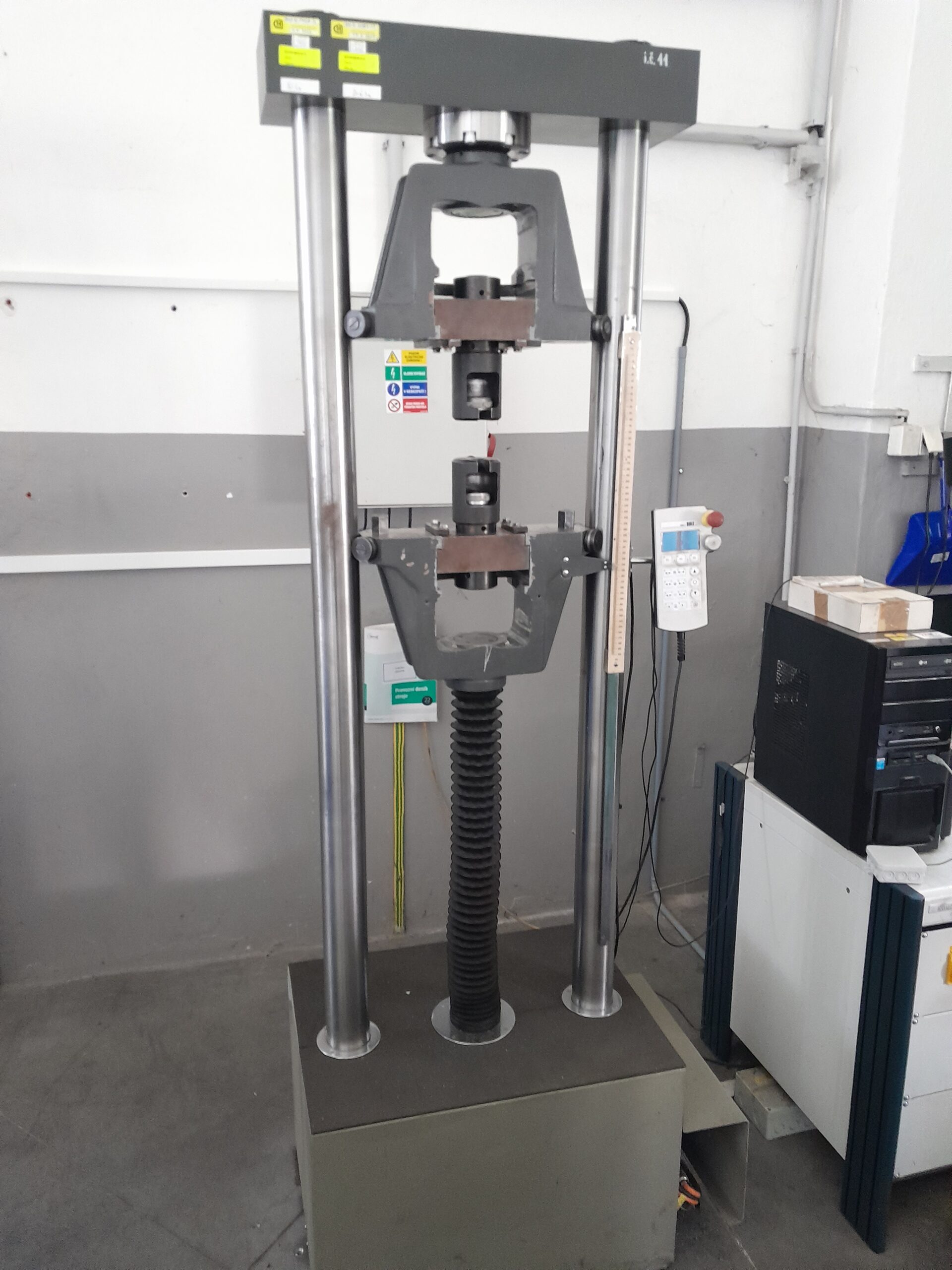
We perform material testing, specifically tensile testing, according to ČSN EN ISO 6892-1. Furthermore, we are able to carry out measurements for atypical specimens, including non-standardized measurement procedures (e.g., testing of bonded and brazed joints, very thin profiles, wood, composite polymer materials, etc.). Two measuring devices are available for testing: for loads up to 100 kN we use the ZD 10/90 universal tensile testing machine, and for loads up to 1000 kN we use the ZD 100 universal tensile testing machine. Tensile test DIAGRAM: The entire process of this test is graphically recorded using a tensile diagram, which illustrates the dependence of stress on the relative elongation of the material. From this data, a number of important material characteristics can then be compared.
Since these are universal machines, other measurements can be performed with a simple modification using fixtures, such as static bend tests, static compression tests, static shear tests, spring testing, dynamic testing, etc.
Material tensile tests are based on two fundamental procedures:
Non-destructive testing of materials and destructive testing of materials examine their mechanical properties, as well as the effect of load on strength and deformation characteristics. The tests can be performed under various environmental conditions, for example:
Tensile testing at ambient temperature
Tensile testing at reduced temperature
Tensile tests are carried out on full-section test pieces, e.g., tubes, wires, and bars of smaller dimensions, on machined specimens of rectangular or segmental section strip types, and on circular section specimens. The length of the test piece, including the ends (the so-called heads) for gripping in the testing machine, must correspond to the size of the tested cross-section. If sufficient material is available, a sample length of 300 mm in the tested direction will be sufficient for most applications.
The Czech technical standard ČSN EN ISO 6892-1 specifies the requirements for testing equipment, types of test pieces, and testing procedures. For certain testing cases, our testing laboratory also refers to the relevant special standards. The list of testing procedures for which the laboratory holds accreditation can be found in the appendix to the certificate.
Charpy pendulum impact test
With the help of the Charpy pendulum impact test, we determine the brittleness of a given material. The test itself consists of breaking a notched test piece with a single blow of a pendulum hammer under conditions defined by ČSN ISO 148-1. This type of material test provides us with characteristic values of the material’s impact resistance at high deformation rates in the form of absorbed energy. The pendulum impact test is usually performed at ambient temperature or at reduced temperatures.
Material testing – laboratory equipment
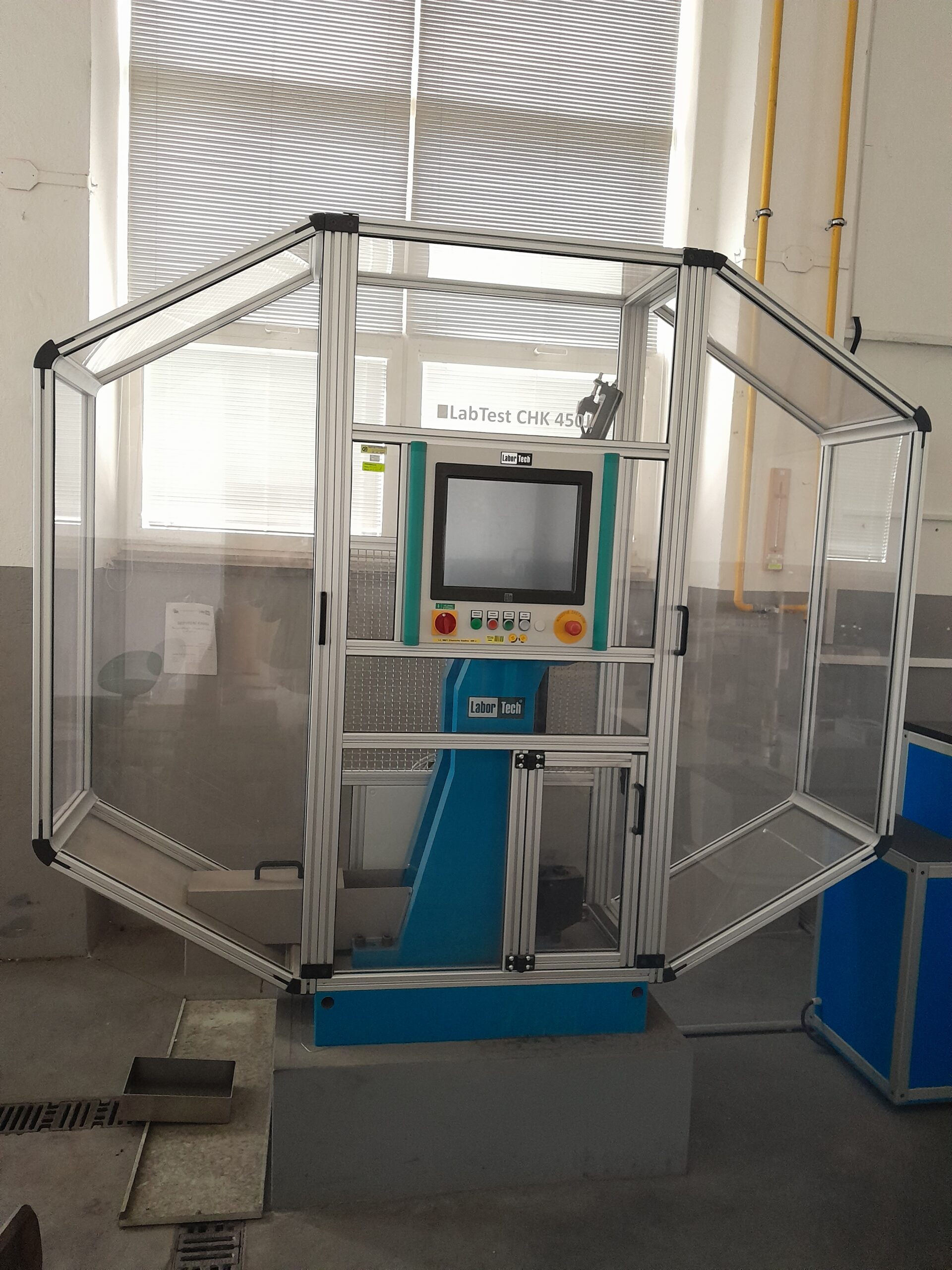
Our testing laboratory is equipped with a LabTest CHK450J Charpy pendulum impact tester with digital angle sensing. We also have an interchangeable 2 mm radius striker according to the ISO standard:
ČSN ISO 148-1
This standard defines the dimensions of the test pieces, the calibration of the testing equipment, and the actual execution of the test at ambient temperature as well as at specified temperatures. The laboratory has equipment for temperature conditioning of test pieces from -80 °C to +20 °C.
The result of the Charpy pendulum impact test is the energy absorbed in breaking the notched test piece. The former conversion to a unit of area is now, with few exceptions, no longer used. All data refer to the standard specimen dimension of 10 x 10 mm with a 2 mm V-notch, i.e., an area of 10 x 8 mm.